

-
Semiconductor Development Companies Set Up
FAR EAST: JAPAN REPORT

Akihiro Komuro The full details of the government’s goal of a next-generation semiconductor development system have been revealed. Led by the Ministry of Economy, Trade and Industry, and in cooperation with the private sector and overseas countries such as the United States, a new company will be established to mass produce next-generation semiconductors, and a new R&D center will be launched. This is the first time that a comprehensive system for research and mass production of advanced semiconductors has been established.
The new structure has two pillars. The “LSTC (Leading-edge Semiconductor Technology Center)” will be established by the end of this year as a research and development center for next-generation semiconductors. The University of Tokyo, Tokyo Institute of Technology, Tohoku University, RIKEN, and others will participate in the LSTC, which aims to be an open R&D platform for both domestic and international use so that the results of research can be put to practical use. The company is also considering collaboration with the National Semiconductor Technology Center (NSTC), which is scheduled to be established in the United States.
-
DATAPOINT: North America Utility Vehicles, 2022 Production: 432,700 Units
Four-wheel off-road Utility Vehicles with side-by-side seating are designed to be used in a variety of recreational, industrial and military applications. When equipped with dumpers, they are commonly used for landscaping, dumping and transporting light materials. Vehicles can be customized with enclosed cabs, tool racks, dumpers and more for use on college campuses, parks, corporate campuses and airports. Suppliers offer a wide variety of gas, electric and diesel utility vehicles.
This information comes from industry interviews and from two proprietary databases maintained by Power Systems Research: EnginLink™ , which provides information on engines, and OE Link™, a database of equipment manufacturers.
Exports: Canada, up to 90%; Mexico, up to 85% for NA markets, and US, up to 40% worldwide.
Market Share: With a combined plant total of 28%, Mexico/US based Polaris leads in production of Utility Vehicles in North America. In second position is Deere with a combined plant total of 12%; third is Kubota with 11%.
Trends: In 2021, annual production of Utility Vehicles in North America increased 2% and production is expected to gain another 5% in 2022. The Covid-19 pandemic fed the demand for Utility Vehicles in recreational, industrial and military applications known as the “Pandemic Paradox” (sales surged during lockdowns). The popularity of outdoor activities increased during the lockdowns as people gravitated to the outdoors and away from indoor group activities.
The increases also were driven by low unemployment, demand for products in the golf industry, federal government incentives and the desire for new equipment/greener technology especially within the sport and utility sectors.
Side-by-Side units, also referred to as Utility Task Vehicle (UTV) models continue to grow in popularity and are edging out ATVs for preference because of their convenience and increased capacity. Most UTVs can accommodate up to six passengers and are primarily designed for off-road use. Production is expected to increase up to 5% by 2025. PSR
Carol Turner is Senior Analyst, Global Operations, for Power Systems Research
-
Hydrogen Fuel Cell Truck News
NORTH AMERICA REPORT

Chris Fisher During the past few years there has been plenty of talk about battery electric power replacing diesel-powered internal combustion engines in commercial trucks. At some point this might be true for short and regional haul freight carriers, but what about the long-haul heavy truck segment?
Currently, the lack of a sufficient charging infrastructure, range anxiety and the extreme weights associated with the batteries are significant deterrents to mass adoption of long-haul battery electric trucks. However, hydrogen fuel cell trucks for long-haul applications appear to be a viable option in this segment. Even though fuel cell trucks currently have a greater range and lighter weight than battery electric trucks, they have the same problem as electric trucks: a lack of refueling infrastructure.
-
Powersports Market Expected To Exceed US$ 50 Billion
Power Systems Research is forecasting global revenue for the Powersports industry to grow from $31.5 billion in 2020 to US$ 50.91 billion in 2030, a CAGR of 6% over the forecasted period.
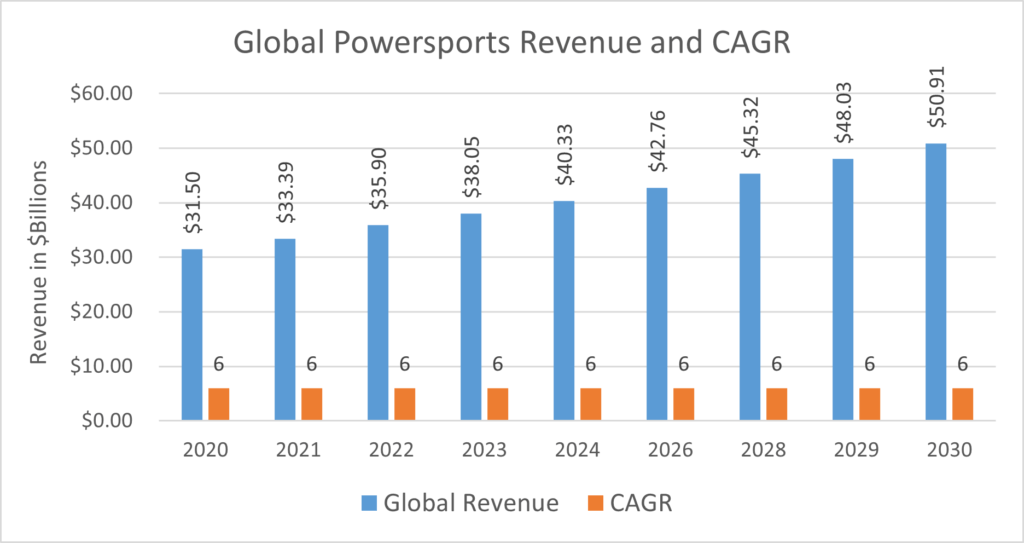
Global Powersports Market
All-Terrain Vehicles, Side-by-Side, Powerboats, Snowmobiles and Heavyweight MotorcyclesDrivers-of-Demand. There are many factors driving the global powersports market growth:
- Increased all-terrain vehicle popularity.
- These include the rising participation in recreational activities, like surfing, off-road driving, and snowmobiling.
- According to the International Snowmobile Manufacturers Association around $36 Billion is spent directly and indirectly on snowmobiling in the US and Canada each year.
- ATVs have lesser age restrictions, lower maintenance costs, are easier to maneuver due to low vehicle weight and are more affordable
- Rise in use of powersports to boost adventure tourism traveling to new locations for gaining new experiences, with controlled risk components and personal challenges in wild & exotic environments.
- People are raising the bar for racing by introducing new terrains and challenges.
- The market in Europe is expected to showcase exponential growth backed by government policies that promote recreational and off-road leisure activities.
- Global governmental initiatives to boost the tourism industry by assisting recreational clubs in enhancing their service offerings are creating a favorable environment for the market participating in the construction of dedicated infrastructure for recreational and amusement purposes.
- Technological innovations have played a major role in developing vehicles.
- New products have increased comfort, power, engineering, and safety.
- Utility-terrain vehicles (UTVs) have improved durability and adaptability for off-road riding.
- Growth in investments and rapid innovations in the automotive sector have resulted in improved performance of powersports vehicles. This has resulted in improved vehicle efficiency, reduced noise and higher power of vehicles. Companies are also focusing on developing electric products for quieter more powerful riding.
- Growing consumer disposable incomes make it easier for customers to purchase leisure and recreational power equipment.
- Data prepared by the U.S. Bureau of Economic Analysis (BEA) show that outdoor recreational activities accounted for US$ 374.3 billion in 2020, which is 1.8% of the overall U.S. GPD in 2020.
Toyota Launches India’s First Flex Fuel Hybrid
INDIA REPORT

Aditya Kondejkar Toyota has launched the Corolla Altis, India’s first flex-fuel engine. This car will be able to run on petrol or ethanol as well as electric power. It is part of a pilot project developing Flexi-Fuel Strong Hybrid Electric Vehicles in India.
Source: Hindu Times Read The Article
Because of the great diversity in India’s consumer population, especially its per-capita income disparity, and multiple applications of vehicles, India might not use one technology but might use a combination of technologies involving various fuel types.
The Indian market can’t simply shift from petrol/ diesel engines to EVs over the next few years. Hence, many OEMs are working on CNG/ hydrogen/ hybrid vehicles. Toyota has launched this new vehicle for the Indian market as part of these efforts.
Urban Railroads Delayed
SOUTHEAST ASIA: VIETNAM REPORT
The development of urban railroads in Vietnam has been significantly delayed. The opening of the second line in the capital Hanoi is expected to be delayed to 2027, and the first line in the southern city of Ho Chi Minh City may not open until the end of 2023.
In addition to financial difficulties, there are cases where administrative authorities are not proactively resolving problems, leading to further delays.
In mid-September, Hanoi City abandoned the planned Hanoi Urban Railway Line 3 (Nhon Hanoi Station), which was planned to run through the center of the city, to open by the end of the year. The line is 12.5 kilometers long. Construction of the line began in 2010, and although it was originally planned to open in 2015, it is believed that the plan has already been changed about five times.
Hyundai Motor and KT Invest in Autonomous Driving
FAR EAST: SOUTH KOREA REPORT
The Hyundai Motor Group and telecommunications giant KT have formed a capital and business alliance. The two companies will invest about 750 billion won in each other by exchanging their shares.
The two companies will jointly develop communication-related technologies to produce autonomous driving equipment. In addition to automobiles, Hyundai Motor is expanding its business in the fields of robotics and urban air transportation (UAM, or flying cabs), and has decided that partnering with KT will enable it to accelerate research and development in fields other than automobiles.
Agri Week 2022 Report: Drones Become Popular
FAR EAST: JAPAN REPORT
Akihiro Komuro Agri Week 2022 is a comprehensive exhibition on agriculture, livestock, and horticulture. It is held twice a year in Kyushu and Kanto. Agricultural materials, smart agriculture products, livestock materials, and products related to industrialization are exhibited. Agriculture Week consists of the following four exhibitions: AGRI TECH (Material & Technology), AGRI NEXT (Next Generation), AGRI PROCESS (Farmer‘s Processing), LIVESTOCK (Livestock Supply & Equipment)
Source: Official HP
PSR Analysis: The drone market is seeing an increase in the number of new entrants. Currently, the market size is estimated to be around 300 billion yen, but some say it will grow to nearly 800 billion yen in five years. This is because the revision of the Civil Aeronautics Law to be implemented this December will lift the ban on Level 4 unassisted visual flights in manned areas. Until now this has been limited to Level 3 unmanned areas. Currently, the use of drones is mainly for spraying chemicals, but it is also being considered for logistics, inspections, civil engineering, and construction.
Mercedes Produces Initial Heavy Trucks in China
CHINA REPORT

Jack Hao Mercedes-Benz heavy-duty truck factory in China has started mass production and its first domestic Chinese heavy-duty truck has rolled off the assembly line. The rollout reflects the Mercedes Benz truck localization project, under which Mercedes is producing heavy duty trucks built specifically for the domestic Chinese market.
The first batch of Mercedes Benz domestic heavy trucks is scheduled to be delivered to customers in early November.
In the process of localization, MB is striving to achieve a balance between high quality and cost. It is working with 150 domestic suppliers to improve manufacturing quality capability and localize the supply of more than 1500 parts. Presently, the localization rate of Mercedes Benz heavy truck Actros series exceeds 50%, and the localization rate of Actros C series is 90%.
Mercedes Benz trucks has established a Mercedes Benz business unit under the joint venture of Daimler Trucks Co., Ltd. and Foton Motor, which have a 50: 50 share ownership.
- Increased all-terrain vehicle popularity.
 DataPoint Reports

TPI
PSR Truck Production Index
Free quarterly global commercial vehicle production report.

Alternative Power Report

The latest EV and power source news including batteries and fuel cells with analysis by PSR experts.

PowerTALK News
Stay informed each month with insights from Power Systems Research’s analysts working around the world as they identify and comment on important news items in the company’s monthly newsletter.
Subscribe View Archive

OE Link™ Offers
Global
Coverage
OE Link™ database provides OEM products, both On-Road and Off-Road, in 12 regions.
Current Reports
Download complimentary reports that show the type of information available from Power Systems Research.
PowerTALK News
Stay informed each month with insights from Power Systems Research analysts working around the world as they identify and comment on important news items in the company’s monthly newsletter.
Subscribe