Like it did with passenger EV rebates in December, Germany has decided to pull the plug on subsidy programs for electric semi-trucks and city buses. What happens to the nation’s commercial EV market now?
When the German government established the funding program for climate-friendly commercial trucks in 2021, the subsidies were seen as a highly effective tool to drive up demand for electric vehicles in the medium- and heavy-duty truck markets.
Volkswagen announced Feb. 4, 2024, that it plans to invest US$ 250 million in Argentina by 2026. Primarily, the funds will facilitate the ongoing production of the Amarok medium pickup truck, coinciding with the imminent launch of its new generation. Additionally, resources will be allocated towards sustaining the production of the Taos SUV.
At the same time, a new stamping line will be established in Pacheco. The investment also will enable the commencement of Ducati Motorcycle production at the Córdoba unit, which currently focuses on Volkswagen transmissions.
The Indian government’s Budget for the fiscal year 2024-25 is emphasizing the automotive industry, with a particular focus on the electric vehicle (EV) ecosystem. The budget reflects a strong commitment to sustainability and green initiatives, aiming to position India as a leader in the global EV market.
This analysis delves into the key highlights and implications of the budget, drawing insights from industry leaders and experts. Here are highlights of Budget.
EV Ecosystem Reinforcement: The government’s pronounced emphasis on bolstering the EV ecosystem through support for the manufacturing and charging infrastructure has been met with widespread acclaim. Finance Minister Nirmala Sitharaman’s commitment to payment security mechanisms for e-buses underlines a strategic approach to encourage public transport electrification.
Inside China a state subsidy is the norm, but outside of China the position is very different. The level of involvement by the central government feels a lot like a subsidy, one that undercuts local manufacturers. The problem is especially acute when it comes to electric car production.
Many of China’s car companies are looking more and more to export markets to absorb some of their production. But for some countries, the electric car onslaught coming from China is seen as a threat to local companies and their workers. The EV revolution was never intended to displace domestic industries and workers but that seems to be happening.
Energy and the environment are the issues that will redefine the trucking industry over the next decade. That’s what Chris Spear, president and CEO of the American Trucking Associations, told a room full of industry experts in November at the annual Cummins-Meritor and Pressure Systems International fleet technology event held in San Antonio, Texas.
But he said the timeline the industry has placed on the adoption of battery electric vehicles (BEV) and to achieve zero emissions are “completely unachievable.”
“It takes time. We’re not going to get there starting in 2030. We’re not going to meet that by 2035. It ain’t gonna happen,” Spear said, “and when it fails, it’s not only going to be embarrassing, it’s going to cost a lot of people their jobs. To me, that’s just unacceptable.”
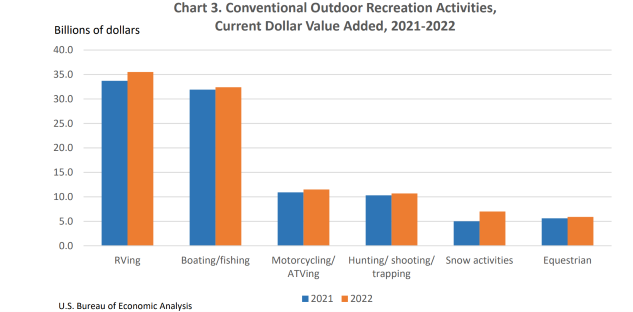
The U.S. Department of Commerce’s Bureau of Economic Analysis (BEA) recently released economic data from the Outdoor Recreation Satellite Account for the year 2022, showing the largest economic impact in its history and outdoor recreation’s economic impact on the U.S. economy.
These new figures reveal that outdoor recreation generates $1.1 trillion in economic output (2.2% of GDP), 4.98 million jobs and comprises 3.2% of U.S. employees.
From 2021 to 2022 the GDP contribution from outdoor recreation increased by 4.8% and employment increased by 7.4%, according to the report.
Outdoor recreation remains a significant sector of the U.S. economy. A wide range of activities—from hiking, boating, and hunting to golf and tennis—result in outdoor recreation jobs in a wide variety of industries
SUMMARY. Many factors are pointing to modest growth in Q3 2023. This should lead to total production globally growing at +2.4% in 2023 vs 2022 (it was 2.6% in Q2 2023), and the outlook for the next few years remains positive with growth accelerating from 2025. Apart from Russia and Ukraine, the main countries to show a decline are South Korea, Slovakia, Netherlands. However, the segment picture shows some differences.
Several drivers are influencing the global economic picture.
Fuel prices eased earlier this year, recently they have grown slightly and are no longer showing signs of easing. This remains a serious issue.
Supply chains remain constrained and show no signs of improving.
The war in Ukraine shows no sign of a speedy conclusion, despite recent successes by Ukraine.
Ukrainian exports of wheat, other grains and fertilizer have declined massively following Russia’s ending on the Grain Deal. Alternative routes (overland, and via the Danube) simply don’t have the necessary capacity.
Inflation is easing, but it continues to be a major concern for central banks as they consider raising their interest rates. This will pose a risk to economic growth in all regions. Inflation and price increases are putting OEMs in a difficult situation.
Risk of recession continues in the background for several countries, notably China, USA and Germany, and this could drag other countries into recession.
Covid is still lingering with global deaths now at over 6.9 million, and a new variant has the medical world concerned.
Latent demand for machinery keeps building, which is a positive sign.
SUMMARY. As we are halfway through 2023, there is more uncertainty with the economy than earlier in the year. The general consensus is there will be a recession coming soon in the United States, and now it is just a matter of whether this will happen later in 2023 or the first of part of 2024.
The latter may be more assumed recently. The stock market has not fallen, and the US economy has not entered a recession this year, 2023. Some of the factors that have prevented this are market investors being enthusiastic over AI (Artificial Intelligence) potential, the Federal Reserve’s pause in interest rate increases, and the slowdown of inflation. So seemingly the pause button has been hit on recession scenarios.
SUMMARY. There are several factors that could contribute to modest growth in the second half of this year as we await final numbers for the quarter. This should lead to total production globally growing at +2.6% in 2023 (vs 2022). Given this 2023 growth, the outlook for the years into 2028 remains positive.
Apart from Russia and Ukraine, the main country to show a decline is South Korea, while Japan is barely positive. However, the segment picture shows some differences.
Fuel prices have eased recently, but they remain a serious concern.
Supply chains remain constrained.
The war in Ukraine shows no sign of a speedy conclusion, despite recent successes by Ukraine.
Ukrainian exports of wheat, other grains and fertilizer continue but are still low compared to pre-war levels.
Inflation continues to be a concern and central banks are raising their interest rates. This will pose a risk to economic growth in all regions. Inflation and price increases are putting OEMs in a tricky situation.
Risk of recession appears in several countries including the USA and Germany.
Covid is still lingering with global deaths now at over 6.9 million, but the death rate has slowed considerably.
Latent demand for machinery keeps bursting out into the open.
Groupe Beneteau, one of the world’s leading manufacturers of pleasure boats and mobile homes, posted revenue of USD 1.6 million (1.508,1 million EUR) for 2022. The boat division generated USD1.3 million (1.250,9 million EUR), 83% of the group’s total revenue.
The Group order books are full for this year. The forecast is for 10% growth compared to revenues achieved in 2022. Last year, revenues by market were at 613.20 million EUR for Europe, 424.4 million EUR for North America and 135.9 million EUR for other regions.
The group plans to launch 13 models in 2023, of which five will be new models of dayboats, four models of sailing yachts, two models of sail catamarans and two models of power catamarans.
The boat division revenues increased 19.7% compared to 2021. The motorboats division contributed 58% of the total and the sailing division added 42%. The best-selling boats are the motor dayboats in size up to 8 meters followed by the sailing multihulls over 10 meters.