

-
Pepsico Acquires 18 Scania Trucks Fueled by NG / Biomethane in Brazil
After the first sale of NG trucks at Fenatran in October 2019, Scania has sold 22 more, including 18 to Pepsico. The forecast of 100 NG Trucks to be sold this year has been reduced because of the pandemic effect.
Source: Estadao Read The Article
-
MotorIndia Sponsors Panel Discussion
MotorIndia is sponsoring a panel discussion of leading industry experts across the commercial vehicle value chain to share their insights on the short- to mid-term challenges in the truck industry.

Jinal Shah The event will be held Wednesday, June 3, at 5:00 pm IST.
The panel will be moderated by Jinal Shah, Regional Director, South Asia Operations, for Power Systems Research (PSR), a leading provider of global production data for engines and equipment.
-
Joint Development of Fuel Cell Trucks Advances
The development of fuel cell vehicles (FCVs) that use hydrogen as a fuel for heavy-duty trucks is accelerating. Since the start of 2020, major manufacturers such as Hino, Isuzu, and Daimler have been announcing cooperation with other companies one after another.

Akihito Komuro In April, Daimler and Volvo announced that they would establish a 50-50 joint venture to develop and mass produce fuel cell heavy-duty trucks.
-
Russia: Assembly of Electric GAZelle LCVs Started in Germany
Sales of electric version of GAZelle Next LCV have begun in Germany. Stuttgart company EFA-S is modifying Russian vehicles. The assembly started this year.

Maxim Sakov The German company purchases LCVs in Russia without transmission, engine and fuel system. Then in Stuttgart they install an electric motor and battery.
Currently, four versions of the electric vehicle are available – a side truck, a wagon, a 2-cabin wagon and a mini-bus. All LCVs are powered by a 110 kWt electric motor and can reach a speed of 88 km/hour.
-
Russia: KAMAZ Tests Driverless Trucks in Arctic
KAMAZ driverless trucks have been tested in the Eastern-Messoyakh oilfield in the Nenetsky region. The vehicles were driven 2,500 kilometers without accidents.
Maxim Sakov The joint project of Gazpromneft and KAMAZ was put together with support of region authorities in difficult climate conditions beyond the Polar Circle. The main target of tests was to determine the efficiency of driverless trucks, which would increase safety of cargo transportation and optimize supplies to territories with difficult access.
During the tests, the driverless trucks showed high potential to move on pre-set routes with high accuracy, to exchange information via duplicated communication systems, to recognize obstacles and forecast movements on actual environment.
-
A New Class of Hybrids
The word “hybrid” in the power generation universe has generally been understood to mean a fossil-fuel engine supplemented by another power source, usually a renewable.

Tyler Wiegert Then, the word grew to include vehicles and equipment that ran primarily on battery power but could be switched to a smaller engine that would recharge the battery while it ran.
Now, we are entering a time when “hybrid” includes drive systems that are primarily renewable-based and supplemented by an additional renewable system.
In this sphere, alternative power has primarily meant batteries and hydrogen fuel cells; one of the major impediments to wide adoption has always been range.
-
PSR’s Coronavirus Special Report

Power Systems Research has created a Coronavirus Special Report detailing the impact of COVID-19 on the global production of Off-Highway and Medium/Heavy Truck Engine and Equipment in 2020.
-
Brazilian Production and Sales of Commercial Vehicles Won’t Recover Until 2021
Power Systems Research analyzes markets of trucks, buses, agricultural and construction machines
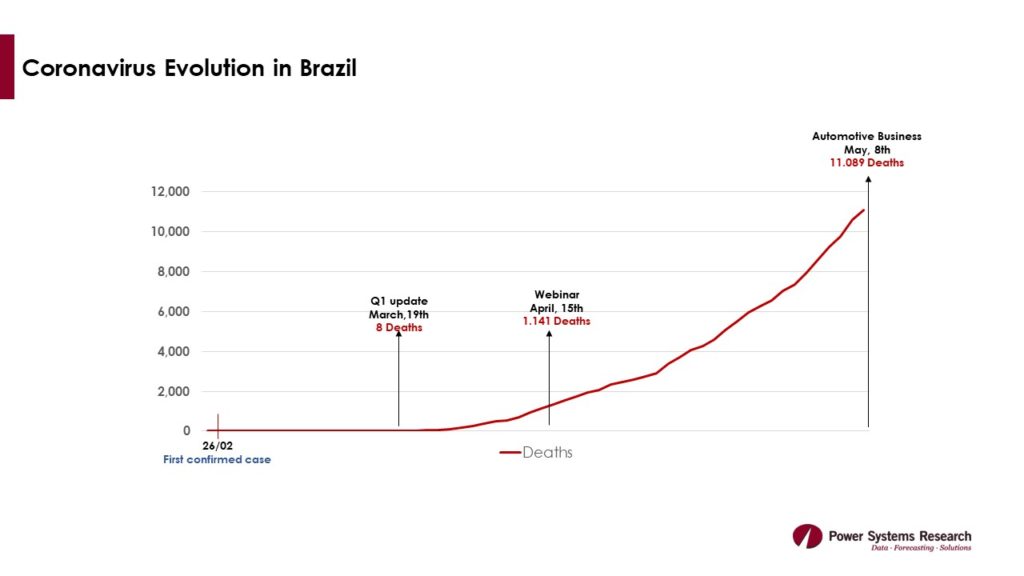
Brazil deaths caused by coronavirus increased sharply in April and May 2020. Slump Caused by COVID-19 Will Last into 2021
The overall slump in production and sales of heavy commercial vehicles (trucks and buses) as well as for agricultural and construction machines should last throughout this year; these segments won’t recover until 2021. PSR
-
RUSSIA REPORT: April 2020
Large Russian Automakers Resume Work After One Week Stop
Many automakers who suspended work March 30 in Russian, as ordered by the government to the reduce spread of the COVID-19 resumed work April 6. The firms including KAMAZ, AutoVAZ, GAZ Group, Mazda Sollers.
Maxim Sakov However, 98% of office personnel are working remotely. Started working YAMZ, Yaroslavl plant of diesel apparatus and some production lines of Likino bus plant. Procurement production of GAZ plant in Nizhny Novgorod is also working. Schedule of main production lines will be determined within a week depending on situation on suppliers’ plants. Read The Article
-
Impact of COVID-19 in India on Engine-driven Applications
As of today, India is relatively less impacted by COVID than other nations. Because of the very bold and unprecedented move of a complete lockdown for about 40 days, India has managed to restrict the number of positive cases to 17,000.

Ritvik Kulkarni Considering that India is a country with a population of over 1 billion persons living in challenging on-ground conditions, it is a phenomenal effort of proactive and timely response from the government as well as restraint observed by citizens.

TPI
PSR Truck Production Index
Free quarterly global commercial vehicle production report.

Alternative Power Report

The latest EV and power source news including batteries and fuel cells with analysis by PSR experts.

PowerTALK News
Stay informed each month with insights from Power Systems Research’s analysts working around the world as they identify and comment on important news items in the company’s monthly newsletter.
Subscribe View Archive

OE Link™ Offers
Global
Coverage
OE Link™ database provides OEM products, both On-Road and Off-Road, in 12 regions.
Current Reports
Download complimentary reports that show the type of information available from Power Systems Research.
PowerTALK News
Stay informed each month with insights from Power Systems Research analysts working around the world as they identify and comment on important news items in the company’s monthly newsletter.
Subscribe