

-
Hyster Begins Pilot of Hydrogen Fuel Cell Powered Container Handler
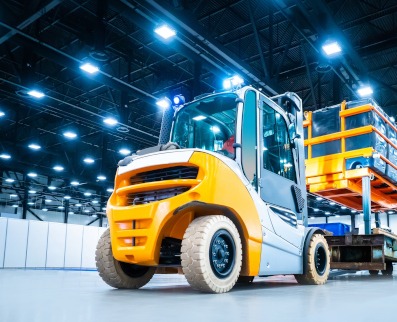
Hyster Company is testing a top-pick container handler powered by hydrogen fuel cells (HFC) at Fenix Marine Services in the Port of Los Angeles.
Based on the standard Hyster H1050-1150XD-CH top-pick container handler design, the truck is powered by two 45kw hydrogen fuel cells from Nuvera, a wholly owned subsidiary of Hyster parent company Hyster-Yale Group. The HFC-powered top pick is designed to provide the zero emissions benefits of a battery electric option, with enough capacity to keep operators moving and avoid the need to stop in the middle of a shift to refuel or recharge.
-
U.S. Economy Faces Multiple Problems
NORTH AMERICA REPORT

SUMMARY. Many of the biggest challenges facing the U.S. economy in 2022 are continuing into 2023. These problems include supply chain disruptions, the migration of production and use of internal combustion engines to alternative drive types, uncertainty of inflation and rising interest rates, and the war in Ukraine.
There were also positives which came out of 2022, including a return to more face-to-face business transactions and meetings. Trade shows made a big comeback in 2022, and this trend will continue in 2023 as the huge CONEXPO-CON/AGG will be held in March in Las Vegas.
The push towards electrification is not all negative either. Innovation and action around alternative drive types will continue to grow.
-
FPT Developing Ethanol or Biomethane Engine in Brazil
FPT, Mahle and Brazilian universities are working to develop an FPT F1C Bi-Fuel engine to meet Brazilian transportation needs using Ethanol, or Biomethane and Hydrogen for use in hybrid vehicle applications.
The project involves the creation of mathematical models, which will be used to characterize and predict the behavior of the engine operating with ethanol and biomethane, assisting in the development of components and hardware, and testing the equipment at Mahle's technology center in Jundiaí…
-
Brazil Moves Forward on Truck Fleet Renewal Program
BRAZIL/SOUTH AMERICA REPORT
In December 2022, the Brazilian Government published regulations for the Fleet Renewal Program authorized by the law that was published in H1 2022. Under this regulation, truck owners may receive the old truck market value from companies in the Oil and Gas exploration chain, provided that they prove the truck was taken out of circulation, disassembly and recycled. The program is voluntary, both for owners selling the old truck and for O&G companies designating…
-
Cost Increases Cause Losses at HanseYacht Group
EUROPEAN REPORT

Natasa Mulahalilovic Cost increases in several areas caused HanseYachts AG to report a loss of EUR 20.72 million (US$25 million) for the fiscal year 2021/2022 ended June 30, 2022. However, because of the great demand during the pandemic for sailing boats and fully complete order books, production increased from 446 to 568 boats, compared to the previous year.
Revenues totaled EUR 132,38 million, an increase of 22.8% compared to the previous fiscal year. But, at the same time, costs of materials increased 40.7%, personal expenses climbed 22% and other operating costs increased 58%. All this led to a net loss higher by 130.5% compared to the previous fiscal year.
The recent Covid-19 shutdown and worker absenteeism heavily impacted the finances of the group for fiscal year 2021/2022.
HanseYacht Group said it will not exhibit this year at BOOT, the biggest indoor pleasure boat trade show held in Dusseldorf, Germany.
-
Electric Light-Duty Trucks Must Meet 5% METI Goal by FY2030
FAR EAST: JAPAN REPORT

Akihiro Komuro The Ministry of Economy, Trade and Industry (METI) now requires shippers that transport a large volume of freight to set a target of using 5% electric light-duty trucks by FY2030, which includes EVs and fuel cell vehicles (CVs), but not hybrids.
They will also be required to submit periodic reports on their progress toward this target. If the efforts are significantly inadequate, the committee can make recommendations to shippers and publicly announce the names…
-
Hyundai Plans $14.7 Billion for Software Development
FAR EAST: SOUTH KOREA REPORT
Akihiro Komuro Hyundai Motor Company is getting serious about developing the software needed for automated driving, etc. It has decided to invest $14.7 billion by 2030 and has begun building a development structure and embarking on M&A.
Hyundai Motor Company has achieved record profits through a shift in strategy in conjunction with a generational change. The company plans to further improve profitability in the software field, where customers can add functions to their cars after purchase. But acquiring human resources will be an immediate challenge for Hyundai.
The “Over the Air (OTA)” function, which updates the latest software via the Internet, will be standard on all new models released in 2023 and after. The plan is to establish a system that allows users to be charged according to function updates. The company will first introduce content such as car navigation systems, audio, lighting, and remote-control functions, and then expand into peripheral areas such as auto insurance policies, to diversify and upgrade services in response to customer needs.
-
EV Purchase Subsidies Planned To Promote Sales
SOUTHEAST ASIA: 6 MAJOR COUNTRIES REPORT
Akihiro Komuro Indonesia plans to introduce a subsidy program to encourage the purchase of EVs starting in 2023. The goal is to increase the number of EV users to 2.5 million by 2025 and reduce air pollution. The EV purchase subsidy program will be added to the list of EV policies introduced by President Joko Widodo over the past year.
Transportation Minister Boudi Karya Sumadi said the government is also considering subsidies for retrofitting internal combustion engine vehicles, but the government is carefully considering this plan because it would bring major changes to the labor-intensive auto industry. The Ministry of Transport plans to approach existing Indonesian automakers, such as South Korea’s Hyundai Motor and China’s BYD, to create an EV ecosystem for Borneo’s new capital city, he said.
-
India Bets on Green Hydrogen
INDIA REPORT

Aditya Kondejkar The electric vehicle market in India is mostly dominated by lithium-ion battery technology, which powers two-, three- and four-wheeler vehicles. But this situation comes with its own set of challenges.
For instance, each battery chemistry has a different energy density, peak power output and charging time. Hence, the industry is working on alternative green solutions, and the government of India is aggressively working on hydrogen as a fuel option.
In terms of refueling…
-
CV Production Nears Pre-covid Levels
INDIA REPORT
Aditya Kondejkar A favorable mix of factors is propelling demand for commercial vehicles to their best-ever pre-covid-19 volumes in India. Even though the CV segment has not reached its 2018 peak, it is expected to grow by double digits in the current fiscal year.
This growth is based on healthy demand and a relatively low base last year. While the sales are in green for all the major OEMs, market leader Tata Motors has reported year-over-year drop of 3%.
Source: Auto News Read The Article
TPI
PSR Truck Production Index
Free quarterly global commercial vehicle production report.

Alternative Power Report
The latest EV and power source news including batteries and fuel cells with analysis by PSR experts.
PowerTALK News
Stay informed each month with insights from Power Systems Research’s analysts working around the world as they identify and comment on important news items in the company’s monthly newsletter.
Subscribe View Archive

OE Link™ Offers
Global
Coverage
OE Link™ database provides OEM products, both On-Road and Off-Road, in 12 regions.
Current Reports
Download complimentary reports that show the type of information available from Power Systems Research.
PowerTALK News
Stay informed each month with insights from Power Systems Research analysts working around the world as they identify and comment on important news items in the company’s monthly newsletter.
Subscribe