-
Global Motorcycle Market Grows at 5.48% Rate
GLOBAL REPORT

Michael Aistrup The global motorcycle market is growing at a healthy CAGR of 5.48%, according to Power Systems Research. Revenue for 2021 was approximately $107.1 Billion and projected to be $146.6 Billion by 2030.
Growth during this period is primarily due to increasing demand from China, India, and ASEAN countries. In addition, growth in traditional markets such as Europe and North America is also anticipated.
The growth of drivers for the Motorcycle industry come from the requirement for cost-effective private transportation among people around the world.
-
Royal Enfield Starts Assembly Plant in Brazil
BRAZIL/SOUTH AMERICA REPORT
Royal Enfield has started its first assembly line in South America to produce motorcycles. The plant is located in Manaus-AM, Brazil and is the fourth in the world to operate under the CKD system.
-
U.S. Powersports Industry Grows in 2021
Michael Aistrup The U.S. Department of Commerce’s Bureau of Economic Analysis (BEA) has released economic data for 2021 showing the outdoor recreation industry’s impact on the U.S. economy. Key highlights from the 2021 data on the U.S. outdoor recreation economy include: 1. $862 billion in economic output; 2. 1.9% of GDP, and 3. 4.5 million jobs.
Trips and travel have come back, record sales in many outdoor segments, manufacturing increasing, as well as the drive to continue to recreate for quality of life has allowed the outdoor industry to bounce back from the effects of COVID-19.
“The continued strength of the outdoor economy is no surprise to the marine industry, where we continue to see incredible growth with new and younger customers taking to our brands each year,” said Chris Drees, President of Mercury Marine, the world’s leading manufacturer of recreational marine propulsion engines.
-
Korean Electric Motorcycle Maker Builds Factory in Vietnam
FAR EAST: SOUTH KOREA REPORT
Zio Holdings, a South Korean company engaged in the production and sale of electric motorcycles, says it has completed an electric motorcycle factory in Bac Ninh Province in northern Vietnam.
The factory covers an area of 1,300 m2 and has an annual production capacity of 12,000 units. The factory will receive parts supplied from original brand factories in Vietnam and China and will assemble the parts at ZIO EV’s factory in Vietnam.
The electric bikes to be manufactured at the new factory will be named “EDEN” and “MEVOYEZ,” and will use LFP batteries (lithium-ion iron phosphate batteries). The maximum speed is 55Km/h, and the driving range is over 150km. The selling price is expected to be 30 million VND (approximately 176,000 yen).
Powersports Market Expected To Exceed US$ 50 Billion
Power Systems Research is forecasting global revenue for the Powersports industry to grow from $31.5 billion in 2020 to US$ 50.91 billion in 2030, a CAGR of 6% over the forecasted period.
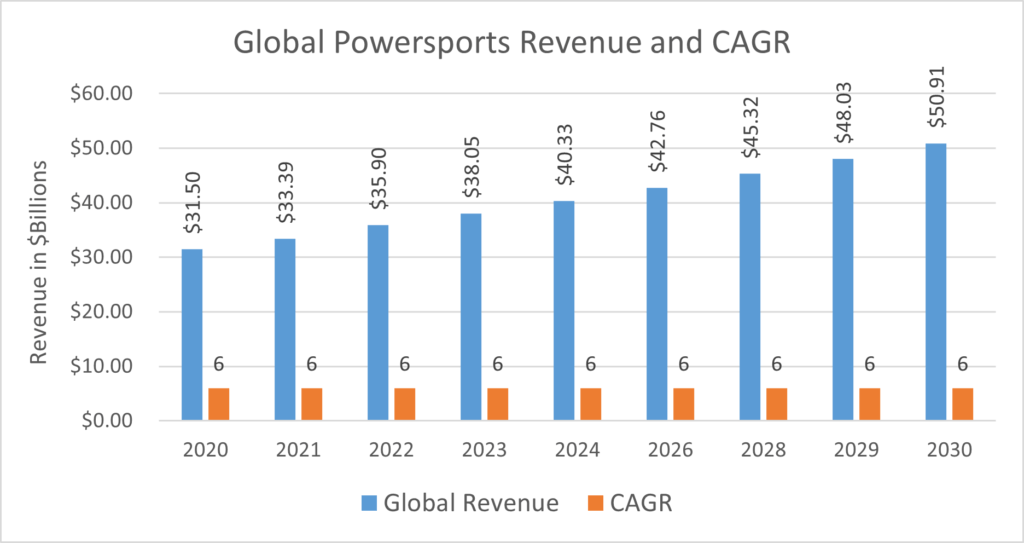
Global Powersports Market
All-Terrain Vehicles, Side-by-Side, Powerboats, Snowmobiles and Heavyweight MotorcyclesDrivers-of-Demand. There are many factors driving the global powersports market growth:
- Increased all-terrain vehicle popularity.
- These include the rising participation in recreational activities, like surfing, off-road driving, and snowmobiling.
- According to the International Snowmobile Manufacturers Association around $36 Billion is spent directly and indirectly on snowmobiling in the US and Canada each year.
- ATVs have lesser age restrictions, lower maintenance costs, are easier to maneuver due to low vehicle weight and are more affordable
- Rise in use of powersports to boost adventure tourism traveling to new locations for gaining new experiences, with controlled risk components and personal challenges in wild & exotic environments.
- People are raising the bar for racing by introducing new terrains and challenges.
- The market in Europe is expected to showcase exponential growth backed by government policies that promote recreational and off-road leisure activities.
- Global governmental initiatives to boost the tourism industry by assisting recreational clubs in enhancing their service offerings are creating a favorable environment for the market participating in the construction of dedicated infrastructure for recreational and amusement purposes.
- Technological innovations have played a major role in developing vehicles.
- New products have increased comfort, power, engineering, and safety.
- Utility-terrain vehicles (UTVs) have improved durability and adaptability for off-road riding.
- Growth in investments and rapid innovations in the automotive sector have resulted in improved performance of powersports vehicles. This has resulted in improved vehicle efficiency, reduced noise and higher power of vehicles. Companies are also focusing on developing electric products for quieter more powerful riding.
- Growing consumer disposable incomes make it easier for customers to purchase leisure and recreational power equipment.
- Data prepared by the U.S. Bureau of Economic Analysis (BEA) show that outdoor recreational activities accounted for US$ 374.3 billion in 2020, which is 1.8% of the overall U.S. GPD in 2020.
Honda To Discontinue Two-Wheeled Gasoline Vehicles
FAR EAST: JAPAN REPORT
On Sept. 13, 2022, Honda announced it will eliminate gasoline-powered motorcycles by the mid-2040s. All new vehicles will be EV motorcycles; 3.5 million, or 15% of global sales, are to be EV motorcycles by 2030. Honda has already declared that all its four-wheeled vehicles will be EVs by 2040, but this is the first time the company has laid out a concrete strategy for decarbonization on two wheels.
From now on, Honda will pursue electrification exclusively with EVs. First, it will launch at least 10 EV motorcycle models by 2025. Since investment in new vehicle development and production facilities will be a heavy burden, Honda will use a common platform for batteries, motors, and other components for three large motorcycle models to be launched in Japan, the United States, and Europe between 2024 and 2025.
Personal Watercraft Production Grows
Michael Aistrup Summary.Technological advancements in the PWC (Personal Watercraft) market have led to the introduction of quieter and cleaner PWCs. PWC manufacturers have also focused their designs on today’s consumer base–families–by continuing to manufacture more of three person models which offer state-of-art features and functions.
The PWCmarket will continue to grow over the forecast period based on an increase in leisure spending and increasing demand of PWC for utilization in sports.
Personal watercraft, also known as a jet ski, is a watercraft having a hull that is driven by an internal water jet pump engine. The PWC is designed in such a way that it does not hold water if it capsizes. PWCs are fast and have the ability to rapidly change direction. PWCs are controlled by a driver who either stands or sits on the watercraft. It is a popular choice for sports and recreational activities.
Initially, PWCs were equipped with a two-stroke engine, but with changing technology, PWCs are now powered with state-of-the-art four stroke engines.
UTV & ATV Market Dynamics
NORTH AMERICA REPORT
Michael Aistrup Market Overview. The global UTV/ATV market size was US$ 8.66 billion in 2021, with a compound annual growth rate (CAGR) of 6.13%. PSR forecasts the global market to grow to US$ 11.67 billion by 2026
The North American UTV/ATV market was valued at US$ 6.66 billion in 2021, and it is expected to reach US$ 8.50 billion in 2026, registering a CAGR of about 5.00% during the forecast period (2022 – 2026).
Applications. UTVs/ATVs were originally associated with sports and recreational activities. Application of these vehicles has diversified, and they are now being used in the agricultural sector and for patrolling, hunting, gardening, and other activities.
A recent application is the United States Army. The military has shown interest in acquiring UTVs/ATVs with features such as rapid transportation, the ability to carry nine fully armed soldiers, agility, and a minimum of 55 mph.
Market Intelligence: A Review of E-Motorcycle OEMs
NORTH AMERICAN REPORT
Michael Aistrup The global e-motorcycle market is changing almost daily as market share leaders develop new products and new companies continue to enter the market with competitive products. Here’s an update on several leading e-motorcycle OEMs.
Tork Motors has launched the Kratos electric motorcycle in the Indian market. The new Tork Kratos will be sold in two variants – Standard and R and will be available across India in a phased manner. In the first phase, this e-motorcycle will be available in Pune, Hyderabad, Bangalore, Chennai, Ahmedabad, and Delhi. The electric motor on the base model makes a peak power output of 7.5kW or 10.05bhp and a maximum torque of 28Nm. Tork has a manufacturing capacity to make about 500 units a month at its pilot plant and about 4,000 units a month at its new plant at Chakan near Pune.
E-Motorcycles Market Update
NORTH AMERICAN REPORT
Michael Aistrup The global e-motorcycle market has experienced high growth in the last couple of years, fueled in part by the declining price of Lithium-ion batteries. The battery is one of the most expensive components of an e-motorcycle, and changes in the price of Li-ion batteries affect the entire cost of an e-motorcycle. The cost of Li-ion batteries has been steadily declining, and this trend is likely to continue.
Power Systems Research has forecasted the global CAGR…
Filter News Posts

TPI
PSR Truck Production Index
Free quarterly global commercial vehicle production report.

Alternative Power Report

The latest EV and power source news including batteries and fuel cells with analysis by PSR experts.

PowerTALK News
Stay informed each month with insights from Power Systems Research’s analysts working around the world as they identify and comment on important news items in the company’s monthly newsletter.
Subscribe View Archive

OE Link™ Offers
Global CoverageOE Link™ database provides OEM products, both On-Road and Off-Road, in 12 regions.
Previous Next
Current Reports
Download complimentary reports that show the type of information available from Power Systems Research.
PowerTALK News
Stay informed each month with insights from Power Systems Research analysts working around the world as they identify and comment on important news items in the company’s monthly newsletter.
Subscribe