

Power Systems Research (PSR) is an international research company based in St. Paul, Minnesota, USA. It operates a second North America office in Detroit, Mich., and has offices in five other countries. PSR analysts have been collecting and analyzing global engine and powertrain data and information since 1976, and we use this data to develop targeted forecasts by industry segment and region.
Our team of experienced analysts works with OEMs, engine and component manufacturers, dealers, fleet managers and industry experts to compile detailed and focused data that has become an industry standard. It’s the leading source of global information on engines and power equipment powered by IC and alternate sources. Whether you need detailed global data, forecasts or customized local market studies, we can provide you with Data, Forecasting and Solutions. Let’s start today.
-
High Energy Density, Cobalt-Free Lithium-Ion Battery Developed
ALTERNATIVE POWER REPORT

Guy Youngs Today’s electric vehicles are predominantly powered by nickel-manganese-cobalt (NMC) lithium-ion batteries. However, the inclusion of cobalt in this type of batteries has been considered problematic due to its anticipated scarcity as well as the associated supply chain risks related to its single source, human rights and mining practices.
Japanese scientists have developed a high energy density, cobalt-free lithium-ion battery that yields about 60% greater energy density than conventional lithium-ion batteries for an equivalent weight and volume and sustains unprecedented 1,000 cycles.
Source: PV Magazine: Read The Article
-
Electrify Where It Makes Sense
NORTH AMERICA REPORT

Chris Fisher Energy and the environment are the issues that will redefine the trucking industry over the next decade. That’s what Chris Spear, president and CEO of the American Trucking Associations, told a room full of industry experts in November at the annual Cummins-Meritor and Pressure Systems International fleet technology event held in San Antonio, Texas.
But he said the timeline the industry has placed on the adoption of battery electric vehicles (BEV) and to achieve zero emissions are “completely unachievable.”
“It takes time. We’re not going to get there starting in 2030. We’re not going to meet that by 2035. It ain’t gonna happen,” Spear said, “and when it fails, it’s not only going to be embarrassing, it’s going to cost a lot of people their jobs. To me, that’s just unacceptable.”
-
Outdoor Recreation Adds $1Trillion to U.S. Economy

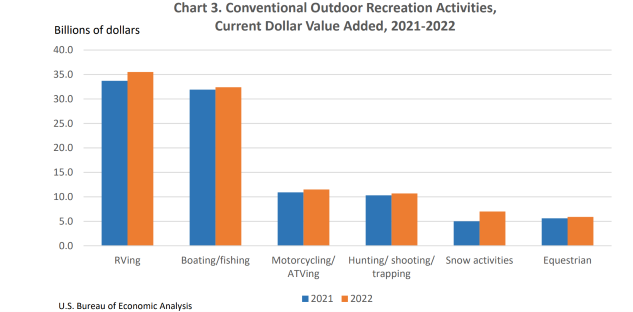
The U.S. Department of Commerce’s Bureau of Economic Analysis (BEA) recently released economic data from the Outdoor Recreation Satellite Account for the year 2022, showing the largest economic impact in its history and outdoor recreation’s economic impact on the U.S. economy.
These new figures reveal that outdoor recreation generates $1.1 trillion in economic output (2.2% of GDP), 4.98 million jobs and comprises 3.2% of U.S. employees.
From 2021 to 2022 the GDP contribution from outdoor recreation increased by 4.8% and employment increased by 7.4%, according to the report.
Outdoor recreation remains a significant sector of the U.S. economy. A wide range of activities—from hiking, boating, and hunting to golf and tennis—result in outdoor recreation jobs in a wide variety of industries
-
China Discovers Unique Battery Material
Guy Youngs A newly discovered ore containing vast quantities of an element widely used in semiconductors has been found in China. The discovery could propel new advances in battery technology.
Geologists have found the rare earth metal niobium inside the new ore named niobobaotite from north China’s Inner Mongolia. The rare earth metal is widely used in alloys for jet engines and rockets and has also been shown to have exceptional current conducting properties in low temperatures.
Researchers have said batteries made from niobium have several advantages over traditional lithium-ion batteries. The Brazilian Metallurgy and Mining Company (CBMM) has been working on new projects towards the use of niobium to make advanced lithium-ion batteries.
Power Systems Research – Headquarters
1365 Corporate Center Curve
Eagan, MN 55121
United States
Tel: +1.651.905.8400
Fax: +1.651.905.8487
info@powersys.com

Power Systems Research – Detroit
Tel: +1.248.444.0545
Tel: +1.651.905.8400
infode@powersys.com

TPI
PSR Truck Production Index
Free quarterly global commercial vehicle production report.

Alternative Power Report
The latest EV and power source news including batteries and fuel cells with analysis by PSR experts.

PowerTALK News
Stay informed each month with insights from Power Systems Research’s analysts working around the world as they identify and comment on important news items in the company’s monthly newsletter.
Subscribe View Archive

OE Link™ Offers
Global
Coverage
OE Link™ database provides OEM products, both On-Road and Off-Road, in 12 regions.
Current Reports
Download complimentary reports that show the type of information available from Power Systems Research.
PowerTALK News
Stay informed each month with insights from Power Systems Research analysts working around the world as they identify and comment on important news items in the company’s monthly newsletter.
Subscribe