Volkswagen is considering keeping its German plants up and running while reinstating job security agreements until 2030, with the tradeoff being that workers would forgo bonus payments, according to an anonymous source.
With the US history as automobile leaders of the 1900s, it is easy to assume the US will continue being the automotive leader globally and especially domestically. However, the US is rapidly being outmaneuvered, out-innovated, and left in the dust by its Chinese competitors – particularly in the field of EVs.
This article brings together several stories relating to the automotive market with particular emphasis on BYD.
Overall, Chinese electric cars are leading the US auto industry, and it’s hard to imagine that story won’t get even more imbalanced in the coming four years with President-elect Donald Trump slowing US progress on EVs.
PSR Analysis: In China, there seems to be a real appetite for innovation, change and growth which seems to be lacking in Europe and the US. Many western auto brands are overpricing their vehicles and cancelling the most affordable models. This short-term outlook may be the end of these brands, as they are struggling to be relevant in today’s market. PSR
Guy Youngs is Forecast & Adoption Lead at Power Systems Research
Mercedes-Benz says it’s developing a solar paint that would allow electric vehicle owners in places like Los Angeles to power their daily driving without ever plugging in.
The German automaker teased the idea recently during a future technology showcase at its R&D center in Sindelfingen, Germany. The photovoltaic material starts as a paste and is applied to body panels in a layer that’s just 5 micrometers thick—thinner than a human hair. Covering every body panel of a mid-size SUV with the material would create 118 square feet of sun-harnessing surface area, a more than three-fold increase compared to the 32 square feet available from a single flexible panel on the roof.
Mercedes claims such a vehicle could capture enough energy to drive about 12,500 miles a year in sun-soaked Los Angeles
PSR Analysis: This is an interesting twist on vehicles with solar panels (Aptera, Sono Motors, etc.) but most of these don’t generate enough energy so I would question the figure of 12,500 miles a year, but even if it’s a quarter of that, it’s still significant savings. PSR
Guy Youngs is Forecast & Adoption Lead at Power Systems Research
The world’s largest EV battery maker is advancing a new type of battery, which promises higher energy density. According to a new local report, CATL is investing heavily while ramping up its workforce to bring all-solid-state EV batteries to market.
The company’s solution has an energy density of up to 500 Wh/kg for lithium ternary batteries, 40% more than current batteries. However, the report said charging speed and cycle life are not quite where they need to be
PSR Analysis: With trial production reportedly kicking off, we could see CATL launch all-solid-state EV batteries soon. The benefits of solid state batteries (higher energy density leading to longer range, rapid charging, safety and lower weight) are well known. PSR
Guy Youngs is Forecast & Adoption Lead at Power Systems Research
The global outboard engines market size was $10.58B in 2023 and is anticipated to reach $19.13B by 2034, growing at a CAGR of 5.53% from 2024 to 2034, according to Power Systems Research (PSR).
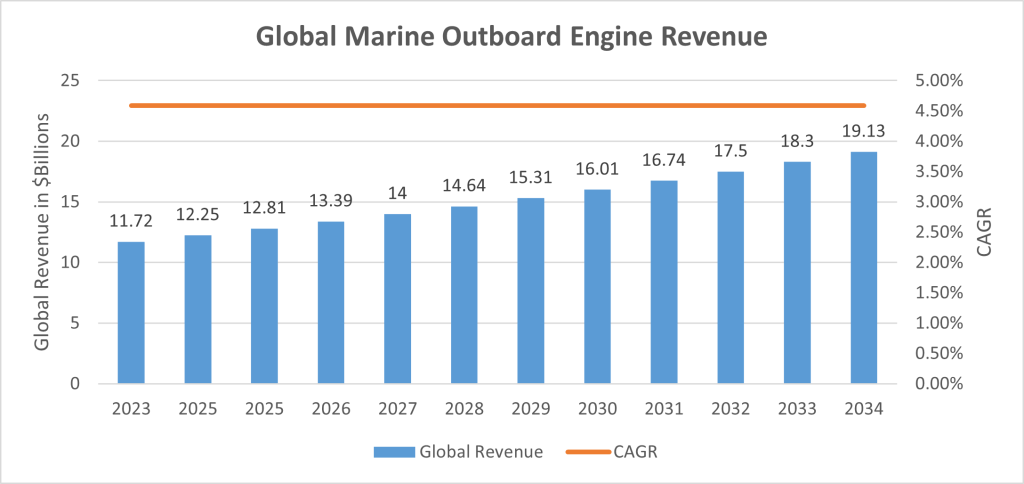
Source: Power Systems Research
Summary. The outboard engines market produces, sells, and distributes outboard motors. These engines are independent propulsion units positioned externally on a boat’s transom instead of being integrated within the hull. These engines, which are used to power a variety of watercraft, such as boats, dinghies, pontoons, and fishing vessels, usually consist of a powerhead, gearbox, and propeller.
Nebraska Attorney General Mike Hilgers has filed an antitrust lawsuit against some of the nation’s largest heavy-duty truck manufacturers alleging a plot to stifle the availability of internal-combustion semi-trucks in favor of electric ones.
In the lawsuit filed Nov. 19, Hilgers said California and the California Air Resources Board have “recently embarked on a mission to eliminate the [internal combustion engine] vehicle and mandate the electrification of our nation’s vehicle fleet.”
While other lawsuits have been filed against California and CARB attempting to halt or slow down the regulations, including one led by Hilgers to block CARB’s Advanced Clean Fleets regulation, Hilgers’ new lawsuit targets manufacturers themselves, including Daimler Truck North America (DTNA), International Motors, Paccar, Volvo Group North America, and the Truck & Engine Manufacturers Association.
Volkswagen Caminhões e Ônibus, in collaboration with Suspensys, has unveiled the VW Meteor Hybrid, Brazil’s first hybrid concept truck. This vehicle features a diesel engine combined with an electric auxiliary axle developed by Suspensys, enabling intelligent traction management that optimizes performance, reduces travel time, and enhances fuel efficiency.
The intelligent traction system allows the third axle to become driven, transforming the truck into a 6×4 configuration when necessary. This provides additional torque for uphill climbs and improved starting power when towing a loaded trailer. Preliminary studies suggest that this setup can decrease travel time due to the extra power.
Additionally, the regenerative system recovers energy during deceleration and in areas with elevation changes, enhancing efficiency and battery storage. The extent of increased autonomy depends on the operation and route. Initial tests estimate that the Meteor Hybrid concept can reduce diesel consumption by up to 10%, depending on the operation’s topography. This directly impacts CO₂ emissions, potentially avoiding over 25 tons annually.
PSR Analysis. This concept aligns with Volkswagen Caminhões e Ônibus’s strategy for decarbonization, as it can operate solely on the diesel engine during long trips without the need for charging infrastructure. This flexibility is particularly useful for routes lacking charging stations, increasing the operational versatility of the hybrid model. PSR
Fabio Ferraresi is Director, Business Development, South America, for Power Systems Research
Volvo Construction Equipment has expanded its Brazilian manufacturing portfolio by localizing production of the A45G articulated hauler at its Pederneiras facility in São Paulo. This model, the largest articulated hauler produced by Volvo in Brazil, is now eligible for BNDES’s Finame financing program, that offers attractive rates and favorable payment terms.
The A45G is designed for industries requiring heavy-duty articulated haulers with a payload capacity of 41 tons, such as mining and heavy construction.
The Thai government says it will relax the requirement for EV manufacturers receiving subsidies to produce a certain number of vehicles by 2024. There had been calls for a revision from Chinese manufacturers and others. This is in response to poor market conditions for EVs.
The Board of Investment (BOI) of Thailand provides subsidies to manufacturers that can be applied to the purchase of EVs. The subsidy amount is up to about US$ 3,000 (100,000 baht or about 440,000 yen) per vehicle, which is about 10% of the purchase price of a medium-sized SUV.
In December, FAW Jiefang began production on its first hydrogen engine in Dalian, Liaoning Province, marking a key step for it in the field of green intelligent transportation.
The project is expected to have a total investment of US$84.41 million (614 million yuan), building medium-sized engines ranging from 5 to 7 liters, heavy-duty hydrogen engines, and production lines. The CA6HV3 production line is the world’s first hydrogen engine production line; it will help FAW Jiefang build a more complete powertrain product line. It is reported that the CA6HV3 hydrogen engine, independently developed by FAW Jiefang, is the first domestic heavy-duty commercial vehicle direct-injection hydrogen engine in China. It leads the country in thermal efficiency and product reliability and achieves zero carbon emissions.