

-
Russia New Car Sales Drop 70% in April
New car sales plummeted by 102,000 vehicles in April, the largest monthly car sales decline in history in Russian, according to the Association of European Business.

Maxim Sakov During April, Russia introduced strict quarantine measures because of the coronavirus, causing car sales to fall by 102,089 units, or 72.4%.
After strong sales in March, dealers have had to suspend or restrict their activity.
“Black April” has dealt a strong blow to dealer cash liquidity, and seriously affected stability during middle-term period. The dealers are preparing to restart their business in May; however, they don’t expect significant sales growth.
AutoVAZ , the largest Russian car manufacturer, reported sales declined by three times in April over March.
-
COVID-19 and Lockdown Have Major Impact on Engine-Driven Applications
Even before the COVID-19 crisis, the Indian automotive sector was facing a severe downturn, but the problems were amplified by the Covid-19 pandemic and the lockdowns across India and the rest of the world. The situation was compounded because India was transitioning from BS-IV to the BS-VI era.

Aditya Kondejkar These are challenging times for the Indian automotive sector because of slow economic growth, negative consumer sentiment, axle load norms, a liquidity crunch, low capacity utilization and potential bankruptcies. The current lockdown has severely affected the entire ecosystem of engine driven applications in India.
For the first time, automobile OEMs reported zero domestic sales and very limited exports in April. According to the Society of Indian Automobile Manufacturers (SIAM), the industry is losing more than $300 million per day.
-
COVID-19 Update: ARGO Tractors Resumes Manufacturing
Production has resumed in ARGO Tractors plants after being shut down for almost two months. Different measures were put in place in order to comply with government health regulations. In April ARGO started to sanitize the factories and prepare to resume operations. Protection equipment is distributed to workers who must keep social distancing and whose temperature is registered at the entrance of the factories.
Source: Argo Tractors Read The A…
-
DATAPOINT: NA Personal Watercraft (PWC) 2020 Forecast: 88,300 Units
The 88,300 units is the estimate by Power Research of the number of Personal Watercraft (PWC) to be produced in North America (Canada, Mexico and the United States) in 2020.
This information comes from industry interviews and from two proprietary databases maintained by Power Systems Research: EnginLink™ , which provides information on engines, and OE Link™, a database of equipment manufacturers.
-
COVID-19 Cuts Results at Harley-Davidson, Polaris
Harley-Davidson Q1 2020 Sales Plunge 15.5%
Harley-Davidson said US sales were up 6.6% in the quarter before the pandemic ground the economy to a halt in mid-March. But sales wound up plunging 15.5% in America compared to a year ago and 20.7% internationally. Overall revenue slipped 8% from last year’s first quarter.
For the quarter, Harley-Davidson posted earnings of $69.7 million compared with $127.9 million in the same period a year ago.

Michael Aistrup Harley-Davidson’s share in the U.S. heavyweight motorcycle market share was down 2.2 percentage points, to 48.9% and the company’s share of the heavyweight motorcycle market in Europe was 7.6% in the first quarter.
In response to the COVID-19 crisis, Harley has reduced planned capital spending, frozen hiring, temporarily reduced salaries, eliminated merit increases for employees in 2020 and changed the timing of new product launches in order to preserve $250 million in 2020.
-
A New Class of Hybrids
The word “hybrid” in the power generation universe has generally been understood to mean a fossil-fuel engine supplemented by another power source, usually a renewable.

Tyler Wiegert Then, the word grew to include vehicles and equipment that ran primarily on battery power but could be switched to a smaller engine that would recharge the battery while it ran.
Now, we are entering a time when “hybrid” includes drive systems that are primarily renewable-based and supplemented by an additional renewable system.
In this sphere, alternative power has primarily meant batteries and hydrogen fuel cells; one of the major impediments to wide adoption has always been range.
-
Vertical Integration Is Key for Competitive Battery Vehicles
R&D World magazine recently examined the global market for lithium-ion batteries and concluded that there could very well be a shortage in the next decade. They projected that recent investments will ensure supply keeps ahead of demand for at least the next two years, but that the demand for lithium in 2030 will be 2.3x higher than the global output in 2019, and investments may not be happening at the pace needed to meet it.
Tyler Wiegert The main bottleneck is that it takes 5-10 years to bring a new lithium or cobalt mine online, but their low prices right now remove some of the incentive to make those investments.
In the absence or shortage of those investments, control of current resources will play a critical role in the production costs of lithium-powered equipment, including on-highway vehicles. In this area, as in many others, Tesla appears to be a leader. The electric car maker has made a number of moves recently to pursue vertical integration, including, most recently, signing a supply deal with Hanwha for battery production equipment. But they are also making moves to secure ownership of the raw materials needed for battery production.
-
PSR’s Coronavirus Special Report

Power Systems Research has created a Coronavirus Special Report detailing the impact of COVID-19 on the global production of Off-Highway and Medium/Heavy Truck Engine and Equipment in 2020.
-
Brazilian Production and Sales of Commercial Vehicles Won’t Recover Until 2021
Power Systems Research analyzes markets of trucks, buses, agricultural and construction machines
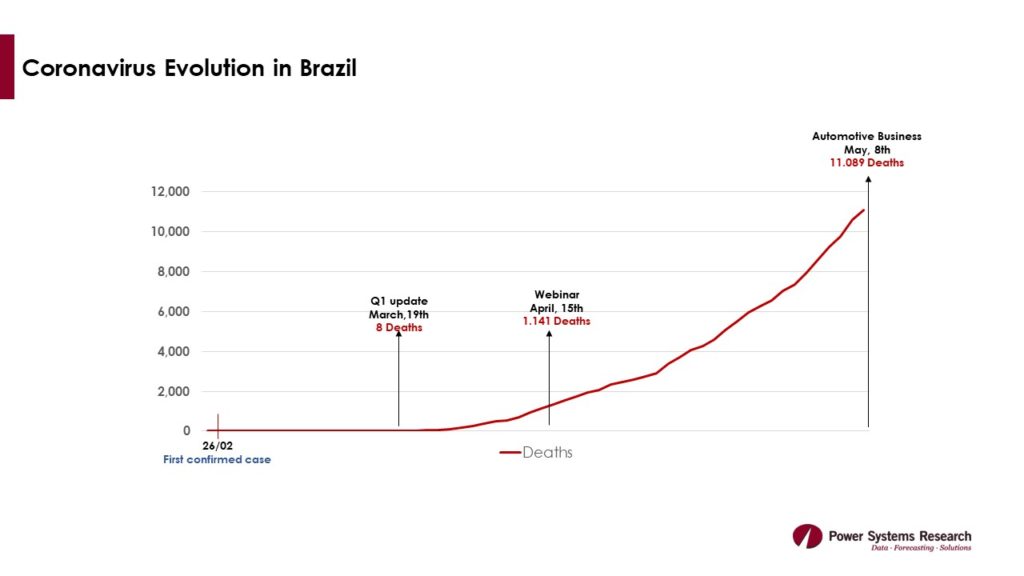
Brazil deaths caused by coronavirus increased sharply in April and May 2020. Slump Caused by COVID-19 Will Last into 2021
The overall slump in production and sales of heavy commercial vehicles (trucks and buses) as well as for agricultural and construction machines should last throughout this year; these segments won’t recover until 2021. PSR
-
SOUTHEAST ASIA REPORT: Spread of COVID-19 Shuts Down Automobile Plants
Due to the spread of COVID-19, Japanese automobile OEMs have stopped production in Indonesia. Isuzu stopped operating its plants April 1, and Honda and Suzuki stopped April 13.

TPI
PSR Truck Production Index
Free quarterly global commercial vehicle production report.

Alternative Power Report

The latest EV and power source news including batteries and fuel cells with analysis by PSR experts.

PowerTALK News
Stay informed each month with insights from Power Systems Research’s analysts working around the world as they identify and comment on important news items in the company’s monthly newsletter.
Subscribe View Archive

OE Link™ Offers
Global Coverage
OE Link™ database provides OEM products, both On-Road and Off-Road, in 12 regions.
Current Reports
Download complimentary reports that show the type of information available from Power Systems Research.
PowerTALK News
Stay informed each month with insights from Power Systems Research analysts working around the world as they identify and comment on important news items in the company’s monthly newsletter.
Subscribe