

-
Hyster Begins Pilot of Hydrogen Fuel Cell Powered Container Handler
Hyster Company is testing a top-pick container handler powered by hydrogen fuel cells (HFC) at Fenix Marine Services in the Port of Los Angeles.
Based on the standard Hyster H1050-1150XD-CH top-pick container handler design, the truck is powered by two 45kw hydrogen fuel cells from Nuvera, a wholly owned subsidiary of Hyster parent company Hyster-Yale Group. The HFC-powered top pick is designed to provide the zero emissions benefits of a battery electric option, with enough capacity to keep operators moving and avoid the need to stop in the middle of a shift to refuel or recharge.
-
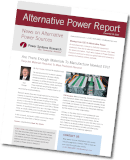
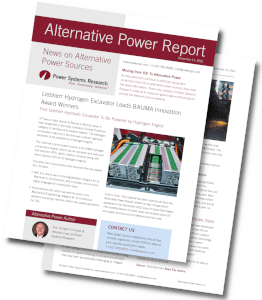
Alternative Power Report, December 2022
Read the expanded December 20222 Alternative Power Report produced by PSR’s Guy Youngs and other analysts at Power Systems Research. This month’s report includes articles on increased battery production in the US., Tesla’s plans for a recycling plant in Texas, increased merger activity in the EV Light/Medium commercial vehicle segment and new power sources being developed for cargo ships.
-
Acquisitions in Light/Medium EV Segment
NORTH AMERICA REPORT

Chris Fisher 2022 has been an interesting year on many commercial vehicle fronts including the medium and light electric commercial truck and van segment. While large established OEMs such as Ford, who is expected to produce approximately 6,500 E-Transits at the Kansas City plant in 2022, there has been some shakeup within the electric commercial vehicle start-ups.
During the past six months, Mullen Automotive, based in Brea, CA, has acquired the assets of the now bankrupt Electric Last Mile (ELMS) company and has acquired 60% of Bollinger Motors, which has yet to start vehicle production.
In September 2022, Mullen Automotive invested $148 million into Bollinger Motors, giving Mullen a 60% share of the company. Bollinger plans on introducing their electric class 3 – 6 lineup of cargo vehicles starting in 2023 and it is likely that Bollinger will also manufacture the Mullen electric light commercial vans also starting production in 2023.
-
Container Ships Could Look Like this by 2050
Here’s What Container Ships Could Look Like by 2050
With pressure from regulators to decarbonize international shipping, companies big and small are racing to identify green alternatives to the gas-guzzling container ships that account for an estimated 3% of global greenhouse emissions.
Many of the ideas floating around today leverage some form of high-tech sail, a futuristic take on the wind-powered voyages that have transported goods for as long as global trade has existed.
Many factors need to be…
-
Are There Enough Materials To Produce Needed EVs?
The transition from ICE to electric vehicles (EVs) is necessary to decrease climate-changing emissions. As deployment increases, so will the demand for EV battery materials such as lithium, cobalt, and nickel. These materials are primarily supplied through two sources: 1) newly mined or 2) recovered by recycling batteries.
Research shows there are enough explored or prospective reserves to electrify the global transportation sector using current technology if a high amount of battery recycling occurs. In this scenario, global demand for EVs in 2100 will amount to about 55% of cobalt reserves and 50% of lithium reserves. If recycling doesn’t ramp up, a shortage of lithium, nickel, or cobalt is likely, and it is estimated that demand would exceed what is economically accessible to extract.
-
Alternative Power Report, November 2022
Read news and analysis from PSR’s Guy Youngs about hydrogen power applications in the November issue of the Alternative Power report by Power Systems Research.
-
JCB Unveils Mobile Hydrogen Refueler

Guy Youngs JCB has unveiled a mobile hydrogen refueler which it says will allow on-site refueling of hydrogen powered machines in the same way that fuel bowsers are used for diesel powered equipment.
The mobile hydrogen refueller is designed to provide an easy way to refuel machines, the vast majority of which have fuel delivered to them while working on site, said the company. JCB said customers are already used to a transportable fuel system.
-
Hydrogen Truck To Help Decarbonize Mining Industry
A new hydrogen fuel truck is being tested by the mining industry in hopes of helping to decarbonize activities that have been exceptionally challenging to mitigate. The mining industry contributes 7% of the world’s total carbon emissions per year, (according to McKinsey). This represents more than twice the carbon emissions from the global shipping industry, for example.
The hydrogen-powered vehicle is meant to replace typical mining haul vehicles, which pollute heavily.
-
50-Ton Battery-Powered Electric Crane Introduced
The 653 E Electro Battery from Sennebogen is a new 50-ton battery-powered electric crane that was developed with Dutch dealer Van den Heuvel. “The new crane combines the benefits of battery technology with the proven advantages of the telescopic crawler crane design,” the company writes. “This means you work completely emission-free and retain maximum flexibility, thanks to the Dual Power Management system.”
With a 210 kWh battery, the crane is expected to be able to operate for up to 14 hours.
-
World Needs To Mine 25X More Lithium
Guy Youngs The de-carbonization of the transport industry is heavily dependent on the scaling up of electric vehicle production rapidly and massively, and this rests on scaling up battery mineral mining and refining. This means Lithium.
Benchmark Mineral Intelligence counts 40 lithium mines that have been in operation and producing lithium in 2022. But, by 2050, the company sees a need for 234 more lithium mines if there’s no battery recycling underway (which, of course, is completely unrealistic but is a place to start from for such an analysis).
“The long term path for lithium is set, yet the supply chain scaling challenge has just begun,” said Simon Moores, chief executive of Benchmark. “What this data shows is that we are at just the beginning of a generational challenge, not one that’s going to be solved in the 2020s.”
TPI
PSR Truck Production Index
Free quarterly global commercial vehicle production report.

Alternative Power Report

The latest EV and power source news including batteries and fuel cells with analysis by PSR experts.

PowerTALK News
Stay informed each month with insights from Power Systems Research’s analysts working around the world as they identify and comment on important news items in the company’s monthly newsletter.
Subscribe View Archive

OE Link™ Offers
Global Coverage
OE Link™ database provides OEM products, both On-Road and Off-Road, in 12 regions.
Current Reports
Download complimentary reports that show the type of information available from Power Systems Research.
PowerTALK News
Stay informed each month with insights from Power Systems Research analysts working around the world as they identify and comment on important news items in the company’s monthly newsletter.
Subscribe